If you own a parking garage in Newark or a multi-family mid-rise in Jersey City, you aren’t just managing real estate—you’re managing a chemical laboratory.
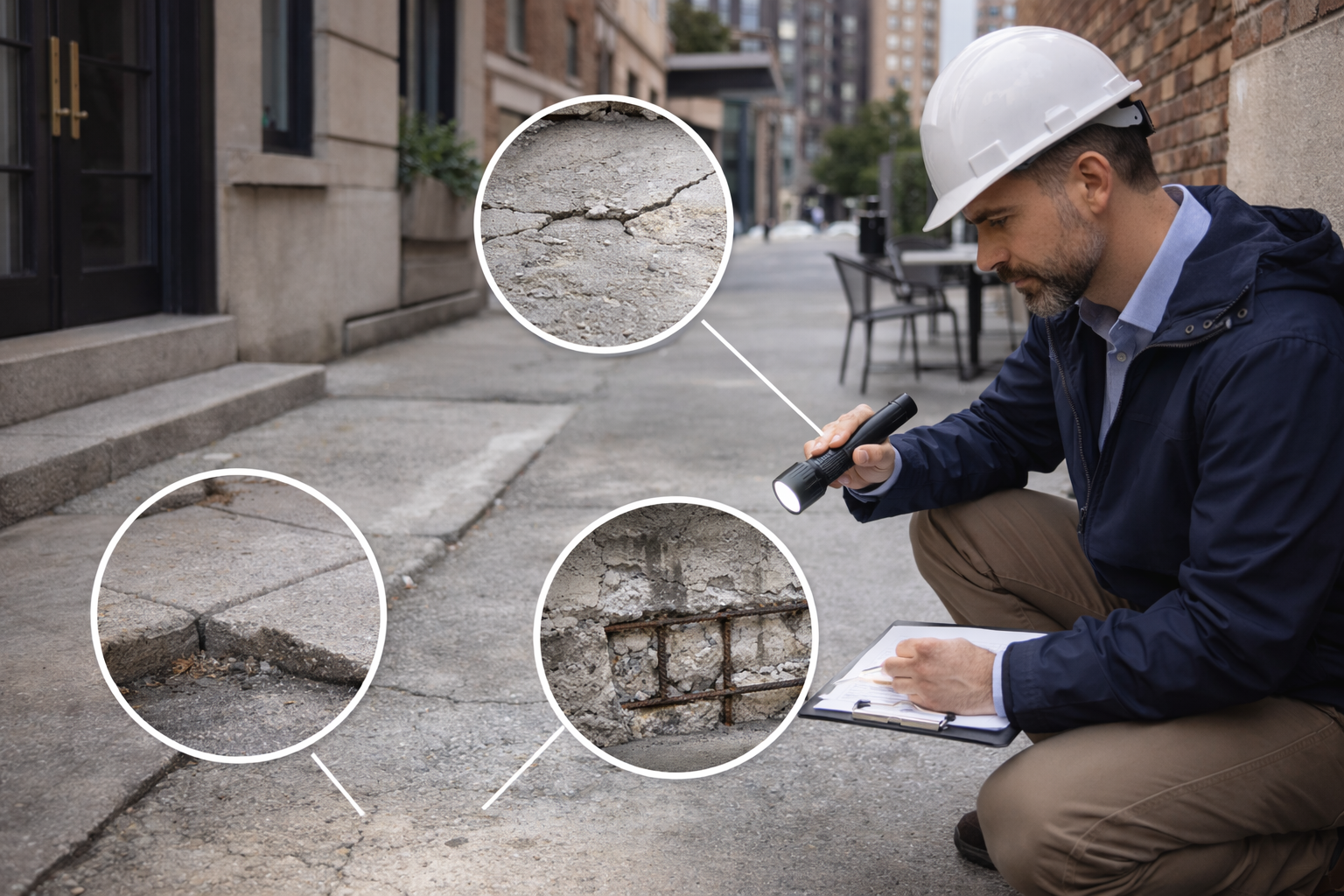
Every winter, hundreds of cars roll into your garage, dripping a toxic cocktail of melted snow and road salt (sodium chloride) onto your concrete decks. At CHK Construction, I’ve seen what happens next, and it isn’t pretty. It starts with a small crack and ends with chunks of concrete, some the size of dinner plates, falling from the ceiling onto a tenant’s BMW.
This isn’t just “old age.” It’s a chemical process called spalling, and if you’re an industrial or commercial property owner in North Jersey, understanding the “why” can save you six figures in structural repairs.
The “Exploding” Rebar: Why It Happens
Concrete is naturally porous; think of it like a very hard sponge. When road salts and moisture seep into the slab, they eventually reach the internal steel reinforcement (rebar).
Here is where the chemistry turns against you:
- Oxidation: The salt acts as a catalyst for rust.
- Expansion: As rebar rusts, it expands to 2–6 times its original volume.
- Internal Pressure: This expansion creates immense “tensile stress” from the inside out. Since concrete is strong under compression but weak under tension, it simply snaps, causing the surface to flake, chip, or “spall” off.
The North Jersey Factor: Freeze-Thaw & Vibrations
In cities like Newark and Jersey City, we deal with the “Double Whammy.” Not only do we have the salt, but we have the freeze-thaw cycle. Water enters a crack, freezes, expands, and widens the gap. Add to that the constant vibration of heavy SUVs and delivery trucks, and you have a recipe for rapid structural decline.
How CHK Construction Stops the Chain Reaction?
When we’re called for concrete repair in NJ, we don’t just slap a patch over the hole. A “patch-only” fix is a waste of your money, the rust will just continue to spread under the new material.
Our professional remediation process includes:
- Surgical Excavation: We cut back the concrete until we find “clean,” non-corroded steel.
- Rebar Treatment: We sandblast the rust away and apply a zinc-rich epoxy primer to the steel to “anodize” it against future moisture.
- Mechanical Bonding: We use high-strength, polymer-modified mortars that chemically bond to the old concrete.
- The Shield (Waterproofing): This is the most critical step. We apply a vehicular traffic coating, a heavy-duty, waterproof membrane that keeps the salt and water away from the concrete entirely.
FAQs
Is concrete spalling a structural threat?
Yes. While it often looks cosmetic at first, spalling reduces the “concrete cover” that protects your building’s skeleton. Once the rebar loses its bond with the concrete, the load-bearing capacity of the slab or column is significantly compromised.
How much does parking garage concrete repair cost in NJ?
Costs vary based on the depth of the damage. Minor surface repairs can be handled per square foot, but structural rebar replacement is more intensive. However, proactive parking garage waterproofing usually costs a fraction of a full-depth structural slab replacement.
Does New Jersey have parking garage inspection laws?
While NYC has specific mandates (like Local Law 126), New Jersey property owners are governed by the NJ Uniform Construction Code. Furthermore, insurance providers often require periodic structural engineering reports for multi-level garages to maintain coverage.
Can you fix spalling concrete without replacing the whole slab?
Absolutely. If caught early, we can perform “partial depth” repairs. By removing the damaged sections and treating the underlying steel, we can restore the integrity of the garage without the massive cost of a full tear-off.
Don’t Wait for the “Falling Chunk”
If you see rust stains (orange streaks) or “hollow” sounding spots on your garage floors, the chemistry is already working against you. In Newark and Jersey City, the best time to waterproof was last year, the second-best time is right now.
Protect your asset and your liability. Schedule a Garage Structural Audit with CHK Construction, Specializing in NJ Commercial Concrete & Waterproofing